
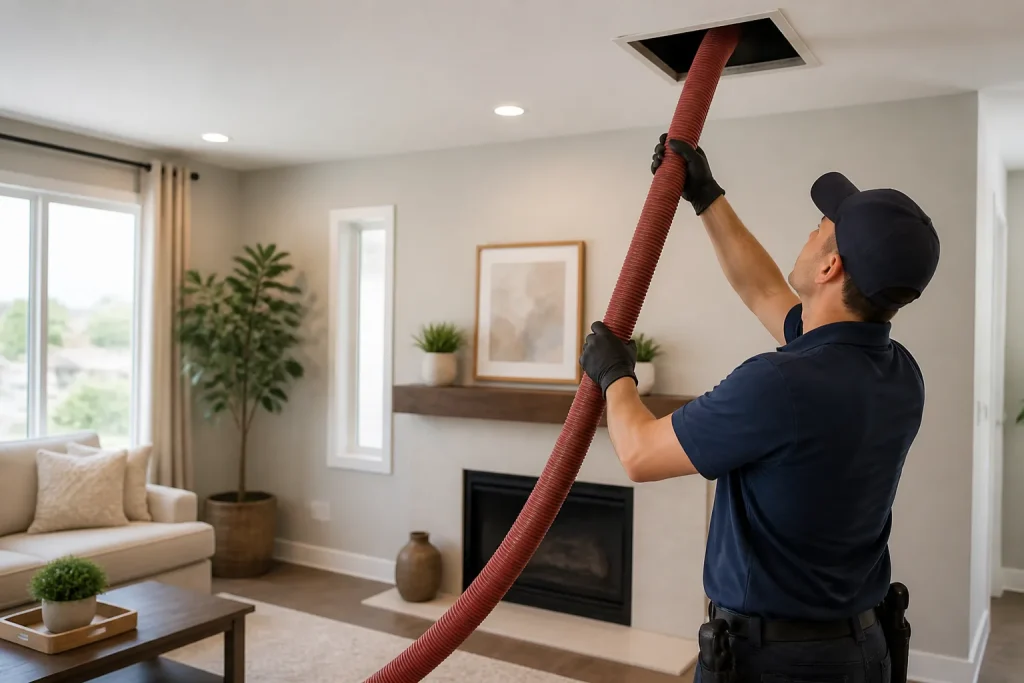
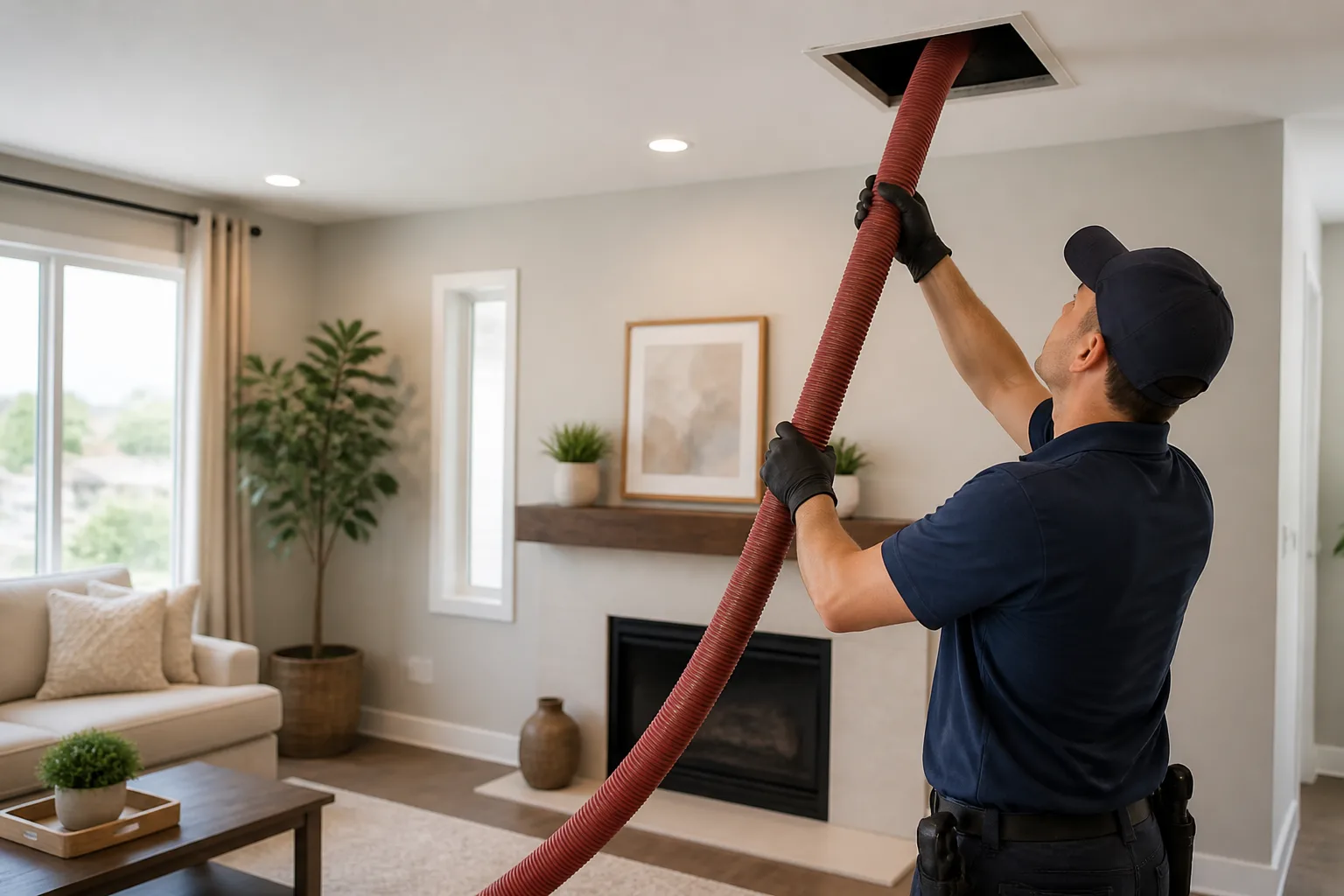
Emergency Air Duct Cleaning Near Me: What Simi Valley Homeowners Should Do First
If your ducts have been exposed to sewage backup, rodent intrusion, or post-fire smoke, the first thing to do is shut your HVAC system off at the thermostat and the breaker. Running it while you search for a cleaning company spreads contaminants through every room faster than almost anything else you could do. After shutdown, document what you can see and touch, then call a company that handles contamination, not just routine dust.
What Actually Counts as a Duct Emergency in Simi Valley
Most calls we get about duct problems are urgent but not emergencies. A musty smell, a dusty return, or a vent that blows weak air matters, but it can usually wait a few days. A real duct emergency in Simi Valley falls into three scenarios, and each one demands a different response.
Sewage backup infiltration. If a drain line backed up into the HVAC return or a condensate pan overflowed into the ductwork, that is biological contamination. You are not dealing with dirt. You are dealing with bacteria, viruses, and organic material that loves warm, dark spaces. The response here is containment first: shut the system down, close the vents in affected rooms, and do not run fans that pull air through the contaminated path.
Post-fire smoke contamination. Simi Valley sits close enough to wildfire country that smoke intrusion happens even when the flames never reach your street. Fine particulate from smoke is not like household dust. It is oily, it clings to duct walls, and it carries compounds that irritate lungs. The equipment and chemistry used for this job differ from what handles routine buildup.
Confirmed rodent intrusion. If you have seen droppings in or around a vent, or heard activity in the duct run, treat it as contamination. Rodent waste in ductwork is a health hazard, not just a smell problem. The ducts need debris removal and surface treatment, and the entry point needs repair so it does not happen again.
Anything less than these three is usually a scheduled cleaning, not an emergency. That does not mean ignore it. It means you have time to vet the company properly.
Shut It Down: The HVAC Protocol Before Anyone Arrives
The single most important action for any of the three scenarios above is stopping airflow. Here is the sequence we walk Simi Valley homeowners through on the phone before we even schedule the visit.
First, set the thermostat to OFF. Not fan, not auto. Off. Then go to the electrical panel and flip the breaker for the air handler or furnace. This prevents any automatic fan cycle from kicking on while you are waiting.
Second, close the registers in rooms closest to the contamination source. If the issue is in a bathroom vent connected to the return, close that bathroom door and the vents feeding that zone. You want to slow the spread, not stop it entirely, because the system is already off.
Third, open a window in the affected area if outdoor air quality is reasonable. The goal is dilution, not circulation through the house. A window lets whatever is airborne leave without pulling it through the ducts. On a heavy smoke day in Simi Valley, skip this step and just keep doors closed.
Fourth, take photos. Before anything is touched, document what you see: water staining, droppings, soot streaks around a vent, damaged duct sections in the attic. Insurance adjusters and remediation crews both work better with before photos. Your phone camera is the cheapest documentation tool you own.
Why Post-Wildfire Smoke in Ducts Is a Different Problem
Smoke from a wildfire is not uniform. It carries burned material from structures, vegetation, plastics, and everything else in the fire path. When that smoke gets pulled into a Simi Valley home through the HVAC system, the residue left in ductwork is a mix of fine particulate and chemical compounds. That changes the cleaning approach.
A routine air duct cleaning job focuses on dust, pet dander, and household debris. Those particles are relatively large and respond well to rotary-brush extraction and HEPA-filtered vacuum collection. Smoke residue is finer and stickier. It adheres to duct walls and requires agitation that reaches the surface, not just the air moving past it. We use Rotobrush and Nikro systems for this reason: the rotary brush physically contacts the duct wall and loosens what air pressure alone leaves behind.
The second difference is what happens after cleaning. With routine dust, the job is done when the ducts are clean. With smoke contamination, you also need to look at the filtration already in the home. If a Honeywell or Aprilaire whole-home filter is installed, the filter media itself likely needs replacement. The same smoke particles that coated the ducts have loaded that filter. Running a clean duct system through a saturated filter just reintroduces the problem.
How to Vet an Emergency Cleaning Company in Under 10 Minutes
When you are stressed and want the problem gone, the temptation is to book the first company that answers the phone. That works sometimes. It also gets homeowners burned when an opportunist shows up with a shop vac and a leaf blower. Here are three questions that separate capable crews from the rest.
Ask what equipment they run. If the answer is vague or mentions only air pressure, be cautious. Proper duct cleaning uses rotary-brush agitation and negative-air collection, the kind of systems built by Rotobrush and Nikro. A company that names its equipment without hesitation is a company that actually owns it. A company that hedges probably rents, borrows, or does not have it at all.
Ask whether they can repair ducts, not just clean them. This matters for rodent intrusion and post-fire damage. If a duct run has chewed openings or heat-warped sections, cleaning alone leaves the problem half-solved. We offer air duct repair alongside cleaning, which means a torn plenum or disconnected run gets fixed in the same visit rather than referred out.
Ask what documentation you will receive. A legitimate contamination job should end with written documentation: what was found, what was cleaned, what was repaired, and photos before and after. If the company cannot commit to that in writing, keep looking. Insurance claims after sewage backup or smoke intrusion often depend on exactly this paperwork.
These three questions take less than ten minutes and tell you almost everything you need to know about how the company operates.
Documentation to Request After the Work Is Done
After a contamination event, the cleaning itself is only half the job. The other half is proving the work happened and recording what was found. Simi Valley homeowners dealing with insurance claims or health concerns should ask for specific items before the crew leaves.
Request a written summary of findings. This is a plain-language document describing what the technician saw: moisture staining, rodent activity, soot deposits, damaged sections. It should note which duct runs were affected and what was done in each one.
Request before-and-after photos. A company running professional equipment should have no problem photographing the duct interior. These photos are the strongest evidence you have that the system was actually cleaned. They also protect you if a claim is disputed later.
Request details on any repairs made. If duct sections were replaced, sealed, or reinforced, get that in writing. Include the location of the repair within the system. This matters for warranty purposes and for understanding whether the underlying problem was solved.
If you have a Honeywell or Aprilaire system, request a note on filter condition and replacement. The filter is part of the contamination equation, and documenting its replacement closes the loop.
What Happens When You Call Us
When you call Duct Cleaning Simi Valley, the first thing we do is ask what you are seeing and smelling. The answer tells us whether this is an emergency contamination job or a routine cleaning that can be scheduled normally. We answer 24/7. Fast dispatch from 7am to 7pm, Sunday through Friday.
If it is contamination, we talk you through the shutdown and documentation steps before we ever put a truck on the road. That prevents the situation from getting worse while help is on the way. When the crew arrives, they bring rotary-brush extraction equipment, HEPA-filtered collection, and the abatement-grade tools to handle biological or heavy debris jobs properly. We work with the equipment already in your home, including Honeywell and Aprilaire filtration, and clean around it rather than past it.
For Simi Valley homes with dryer vent cleaning needs, that service runs on the same principle: remove the fire hazard, document the work, and show you the evidence.
The Bottom Line
A true duct emergency in Simi Valley is rare, but when it happens, the first hour matters more than the cleaning itself. Shut the system down, document what you see, and call a company that answers specific questions about equipment, repair capability, and documentation. Contamination from sewage, smoke, or rodents is not a routine dust job, and the crew you hire should know the difference.
If you are in Simi Valley and dealing with a duct contamination issue, call (855) 353-2270 for a free estimate. We answer 24/7. Fast dispatch from 7am to 7pm, Sunday through Friday. We will walk you through the first steps on the phone before the crew arrives.
Frequently Asked Questions
Can emergency air duct cleaning be done the same day?
Yes, same-day service is available for true contamination emergencies. We answer 24/7, and dispatch runs from 7am to 7pm, Sunday through Friday. A call outside dispatch hours is booked into the next opening. The first step on any emergency call is the shutdown protocol, which we walk you through by phone while the crew is on the way.
How much does emergency air duct cleaning cost in Simi Valley?
Emergency duct cleaning is priced per job by a written estimate, not by a flat rate. Contamination work costs more than routine cleaning because it involves specialized equipment, containment, and documentation. The final price depends on the size of the system, the type of contamination, and any repairs needed. Estimates are free, and the price is agreed before work begins.
Why are some emergency duct cleaning quotes so much cheaper?
Cheap emergency quotes usually mean one of two things: the company is running compressed-air blowouts that redistribute debris rather than removing it, or the quote is a teaser that grows once the crew arrives. Rotary-brush extraction with HEPA collection is slower and more expensive to run, but it physically removes contamination. A company that cannot name its equipment or show before-and-after photos is likely cutting corners you will pay for later.
How do I know the emergency duct cleaning was actually done correctly?
Ask for before-and-after photos of the duct interior, a written findings summary, and documentation of any repairs. A capable crew running professional equipment can photograph every duct run they clean. If a company cannot or will not provide this documentation, treat that as a red flag. The photos are your proof the work happened and your leverage if an insurance claim needs support.
Written by the team at Duct Cleaning Simi Valley, serving Simi Valley since 2013.
Need Air Duct Cleaning Help?
Call Duct Cleaning Simi Valley - licensed & insured, here with fast help in Simi Valley.
(855) 353-2270